The Hidden Problem With Agents That Run for Months
A demo agent runs for ten minutes. A production agent runs for months. A whole class of problems only shows up on the long horizon, and you cannot fast-forward a demo to find them.
The demo horizon and the production horizon
A demo has a shape. It starts fresh, runs for a few minutes, covers one task, and ends. Nothing in it has been around long enough to go wrong. The agent remembers everything you said, because you said all of it a minute ago. The facts are current, because nothing has had time to change. No past decision needs explaining, because there is no past yet.
Production has the opposite shape. It starts fresh once and then never resets. A real agent accumulates history for as long as the user keeps coming back, which for a useful product means months or years. Over that span, the three things a demo takes for granted stop holding. Information piles up, facts change, and old decisions need to be explained. A short run tests none of this, so teams ship having tested none of it.
This is why long-running agents fail in a way that feels sudden. Nothing broke in testing, because the failures need elapsed time to form. The agent does not fall over in the first hour or the first day. It degrades over the first few months, slowly, while the surface metrics a demo would catch stay green.
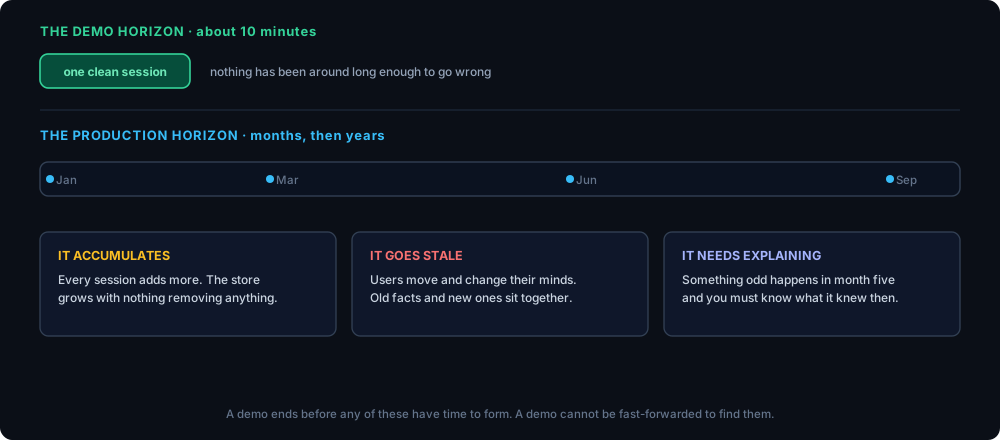
- A demo is short and consistent and ends quickly, so nothing in it has time to go wrong.
- Production never resets, so history piles up, facts change, and past decisions need explaining.
The store only grows
The first thing that happens over months is plain: the memory gets bigger. Every session adds more facts, more messages, more context to whatever the agent keeps. With no mechanism to remove anything, the store grows without bound, and everything downstream of it grows too.
Cost goes up. Most agents pull recent or relevant history into the prompt on every turn, and a larger store means more to search, more to rank, and often more to send to the model. A user who has been around six months is more expensive to serve than one who signed up yesterday, purely because of how much has piled up behind them.
Latency goes up with it. Retrieval over a small store is fast. Retrieval over a store that has been filling for a year is slower, and the agent that felt instant in the demo starts to lag for the people who use it most. A product that gets worse the more someone relies on it is moving in the wrong direction.
Noise grows fastest of all. A year of interactions holds a lot of one-off remarks, resolved issues, and details that mattered for a single afternoon. Keep all of it and every query has to compete with a thick layer of stale, low-value records. The useful facts are still in there. They are just harder to find.
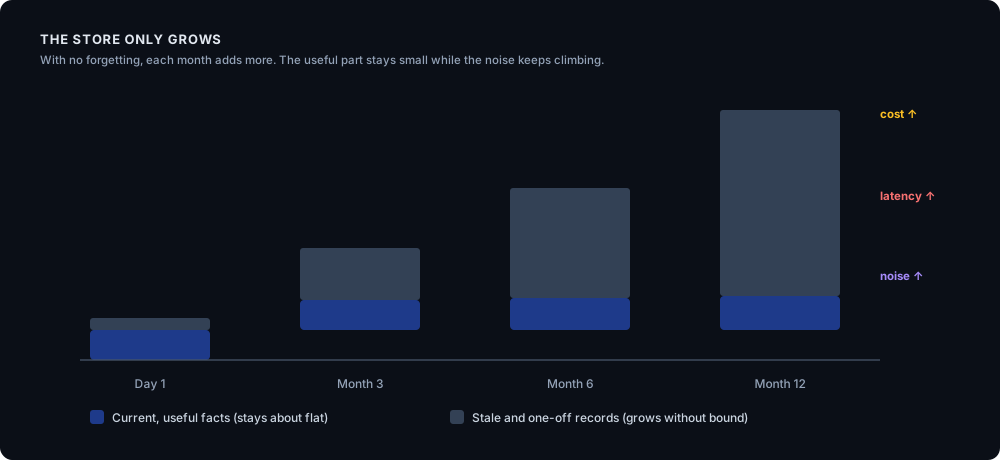
- With no forgetting, the memory store grows without bound as months pass.
- Cost, latency, and noise climb with it, so the product gets worse for your most active users.
The world changes under the agent
Growth is the easy problem. The harder one is that the facts an agent stored months ago do not stay true. People move, switch plans, change their minds, finish projects, start new ones. A memory that was accurate in March can be wrong by June without a single character of it changing, because the world it described moved on.
A demo never sees this, because a demo happens in one moment. Nothing a user says in a ten-minute session has time to be contradicted by something they say later. Over months, contradiction is routine. A user who told the agent they lived in Bangalore tells it later they moved to Mumbai. Both statements now sit in memory, both were true when said, and nothing marks which one describes today.
When a stale fact and a current fact both come back for the same query, the agent has no way to choose. It might answer with the old city, blend the two, or go with whichever ranks higher. The failure is easy to miss. The agent sounds just as sure reciting an address the user left a year ago as it does reciting the right one.
Overwriting the old fact is not a clean fix either. Sometimes you genuinely need the history: what the user's plan was when they filed a complaint, where they lived when a contract was signed. The agent has to keep the old fact, mark it as no longer current, and tell the two apart. That is real machinery, and nothing provides it by default.
- Over months, stored facts go stale as users move, switch plans, and change their minds.
- Old and current facts pile up together, and with no way to tell them apart the agent answers from whichever one surfaces.
The slow decline nobody notices
Put growth and staleness together and you get the counterintuitive part. You would expect an agent to improve as it learns more about a user. More data, better answers. In practice a long-running agent often gets worse, because noise and stale information grow faster than the stock of genuinely useful, current fact.
Retrieval is the choke point. An agent can only act on what it pulls into the prompt, and it pulls a fixed handful of records each turn. Early on, when the store is small and fresh, those few records are almost always the right ones. A year later the same query has to find the right few among thousands, many of them out of date, and the chance that the fact you need makes the cut drops. The agent is not getting dumber. Its memory is getting harder to search.
The decline is gradual, which is what makes it dangerous. There is no day the agent breaks. It answers a little less reliably each month, and because each single answer still looks plausible, nobody catches it until a user says the assistant they have leaned on for a year feels worse than it did at the start.
A second cost shows up only on the long horizon. When a long-running agent does something strange, you often need to know what it knew at the time. If the memory overwrites old facts in place, that history is gone, and you cannot reconstruct why the agent acted the way it did three months ago. Debugging a long-running agent means being able to look at a past state, and a flat, overwritten store cannot show you one.
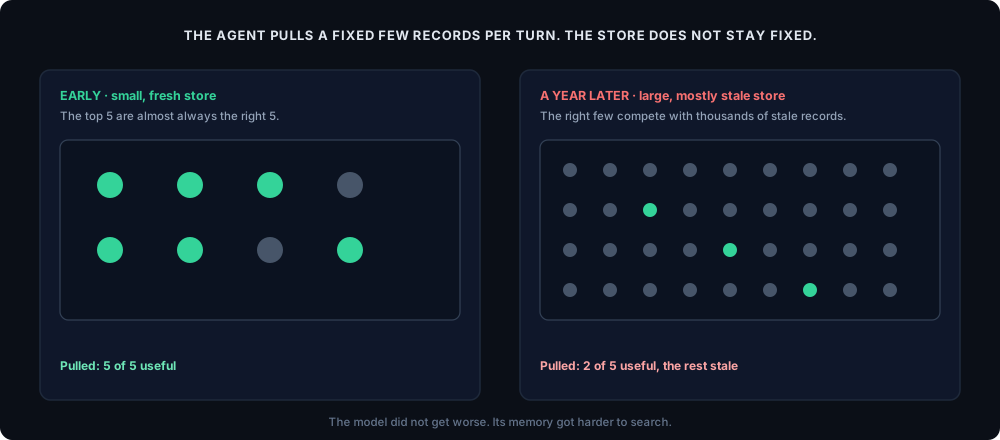
- Noise grows faster than signal, so retrieval surfaces the right facts less often as the store ages.
- The decline is gradual and each answer still looks plausible, so the regression goes unnoticed for a long time.
What running for months actually requires
The common thread is that a long-running agent needs a memory that manages itself over time, instead of a store that only ever gets bigger. Four jobs matter, and they line up with the four failures above.
It has to forget. Low-value and resolved information should decay, so the store stays about the size of what currently matters rather than the sum of everything that ever happened. Forgetting is what keeps cost, latency, and noise from climbing forever.
It has to update. When a fact changes, the old version has to be retired so the agent stops treating it as current, while still being kept for the cases where the history matters. That is what ends the stale-fact contradictions.
It has to track time, so the agent can tell what is true now from what was true then and answer a question about the past without confusing it with the present. And it has to keep its own history, so that when something goes wrong months in, you can see the state the agent was actually working from.
This is the layer Suprflo is built to be. It runs on Postgres, extracts durable facts from conversations, retires them when they change, keeps the old versions instead of overwriting them, and lets low-value memories decay, so an agent behaves the same on day three hundred as it did on day one. None of the problems in this post show up in a demo. They show up in production, a few months in, right when an agent is starting to matter. They are worth designing for before you get there.
Frequently asked questions
Why do long-running AI agents get worse over time?
Because their memory grows without any cleanup. Every session adds more facts, old ones go stale, and the useful records get buried under noise. The agent pulls a fixed handful into each prompt, so as the store fills with outdated entries, the chance it retrieves the right fact drops.
Why don't these memory problems show up when I test my agent?
Because they need elapsed time to form, and a test runs for minutes. In a short session nothing accumulates, no fact has time to change, and no past decision needs explaining. The failures of a long-running agent only appear after months of real use, which a demo cannot fast-forward through.
Is a bigger context window enough for an agent that runs for months?
No. A bigger window holds more of the current conversation, but it is still rebuilt each call and cleared afterward. It does not retire stale facts, bound growth, or preserve history. A long-running agent needs persistent memory that manages facts over time, which lives outside the prompt.
How do you stop an agent's memory from filling up with stale facts?
You add a memory layer that updates and forgets. When a fact changes, it retires the old version instead of leaving both in the store. Low-value and resolved records decay over time. That keeps retrieval focused on what is currently true, so the store does not grow without bound.