Is a Vector Database Actually a Memory System?
Dropping your chat history into a vector database feels like giving an agent memory. What you actually get is fuzzy search over old messages, and the gap between that and memory is where production agents break.
What a vector database actually does
A vector database has one core job. You hand it text that has been turned into an embedding, a long list of numbers that places the text somewhere in a high-dimensional space, and it stores that vector. At query time you embed the query the same way and ask for the stored vectors closest to it. It returns the nearest few by similarity. That is the whole contract: store vectors, find the nearest ones fast.
This is genuinely useful, and the engineering behind fast nearest-neighbor search at scale is hard and worth having. But notice what the database reasons about. It compares vectors by distance. It has no idea that a vector stands for a fact, whether that fact is current, or how two of them relate. To the index, "I live in Bangalore" and "I moved to Mumbai" are just two nearby points.
- A vector database stores embeddings and returns the nearest ones by similarity.
- It compares points by distance, with no concept of facts, truth, or time.
What you get when you dump chat history into one
Embed every message and store it, and you get a real capability: you can search your conversation history by meaning instead of keywords. Ask "where does the user live?" and the messages that mention a city float to the top. For a single short conversation, that can look exactly like recall.
The trouble is what comes back. You get raw message chunks ranked by similarity, not answers. If the user mentioned a city three times across six months, all three come back, ranked by how closely they match the query rather than by which one is true now. Nothing in the pile marks one as a fact, retires the outdated ones, or tells the model which to trust. The database did its job perfectly and still left the hard part undone.
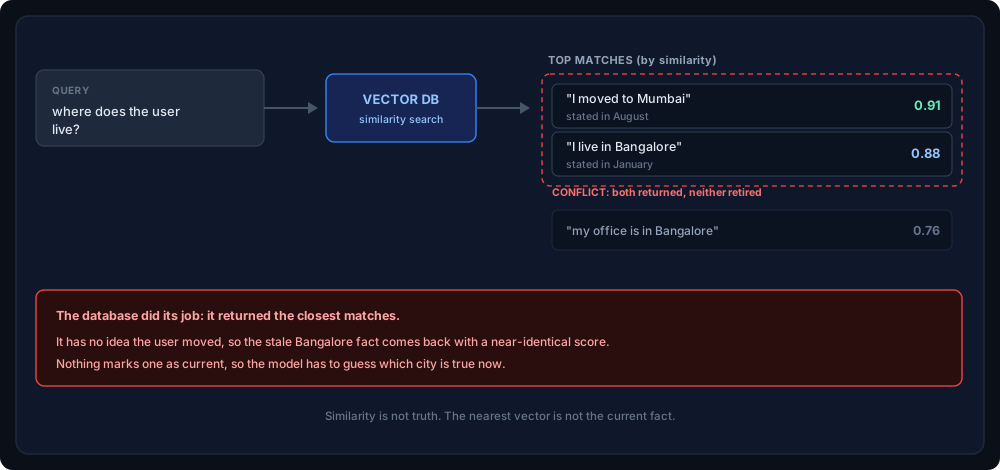
- Embedded chat history gives you semantic search over past messages, which is useful.
- It returns similar message chunks, not resolved, current facts.
What a memory system does that the index does not
Memory is the work that sits between raw similarity search and a usable answer. Four jobs make the difference, and a bare vector database does none of them on its own.
Extraction. A conversation is mostly noise around a few facts worth keeping. Memory reads the messages and pulls out the fact, "the user lives in Mumbai," as a clean record. A vector database stores whatever you give it, so without an extraction step you are searching over small talk and system messages too.
Updating. When a fact changes, something has to retire the old version. A vector database will happily hold both "Bangalore" and "Mumbai" and return both, because both are close to the query. Memory marks the old one as no longer current, so the agent stops seeing it.
Time. Embeddings carry no sense of when. Memory records when a fact was true, so an agent can answer "where did the user live when this project started?", a question plain distance cannot touch.
Forgetting. A vector database never forgets, so every stray remark piles up and the noise grows with use. Memory lets low-value information decay, so retrieval stays sharp as the history gets longer.
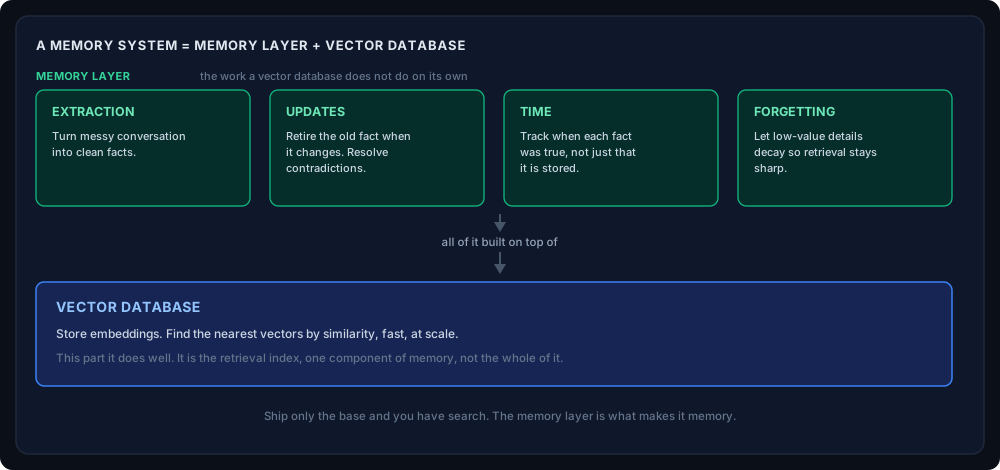
- Memory adds extraction, updating, temporal awareness, and forgetting on top of search.
- A bare vector database does none of these; it only ranks by similarity.
Why the demo works and production does not
The illusion holds up in a demo for a simple reason: a demo conversation is short, internally consistent, and frozen in a single moment. With a handful of messages and no contradictions, top-k similarity returns the one relevant fact, and it looks like memory. The missing machinery never gets tested.
Production breaks all three assumptions at once. Conversations run for months, the same fact gets stated and restated, and people change their minds and their circumstances. Now similarity search returns five near-duplicate chunks, two of them out of date, and the model has to guess. The vector database is working exactly as designed. It was simply never designed to be memory.
- In a short, consistent demo, similarity search looks like memory.
- At production length, contradictions and stale facts expose the gap.
So where does the vector database fit?
None of this means a vector database is the wrong tool. It is the right tool for the job it actually does: fast similarity search. The mistake is asking it to be the whole system. A memory system uses a vector database as one component, the retrieval index, and adds the extraction, updating, temporal logic, and forgetting around it.
That is how Suprflo is built. The vector search runs on Postgres with pgvector, so you keep the nearest-neighbor retrieval you wanted, and the memory layer on top extracts facts, resolves conflicts, tracks when each fact was true, and lets old information decay. You get both the index and the system around it. If you have a vector database full of chat history and your agent still contradicts itself, this is the layer you are missing.