Why Do AI Agents Forget?
A language model keeps nothing between calls. What feels like memory in a chatbot is the app resending the transcript, and that trick stops working as agents run longer.
The model does not remember anything
A large language model is closer to a function than to a person. You give it text, it returns text, and it holds no state between calls. The model that answered you a second ago keeps nothing from that exchange once the response is sent. The next call starts from zero.
That surprises people, because chatbots feel continuous. You can say "my name is Priya" and then ask "what is my name" and get the right answer back. It looks like the model filed the name away, but it stored nothing.
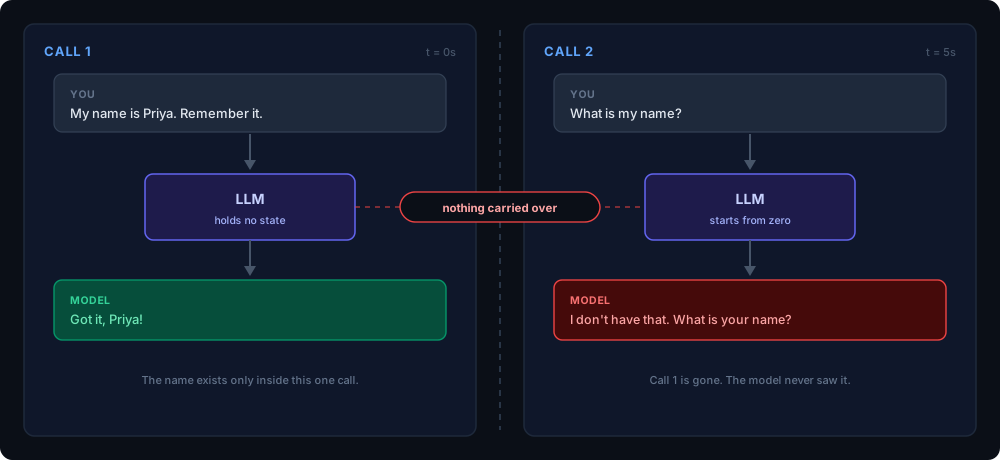
- An LLM call is stateless: it keeps nothing between requests.
- Any sense of continuity comes from the application, not the model.
The context window is a scratchpad, not memory
Chat products create continuity by resending the conversation. Every time you send a message, the app prepends the earlier turns and hands the whole transcript back to the model. The model reads the name in that transcript and answers correctly. It is not recalling the fact. It is re-reading it.
The space the model reads from is the context window. Think of it as a whiteboard the app rewrites before every turn. Whatever fits on the board is available; whatever falls off is gone. The model has no drawer to file things in and no way to look something up later. It sees what is on the board right now, and nothing else.
- What looks like chat memory is the app resending the transcript every turn.
- The context window is re-read each turn, never stored between them.
Why resending the transcript stops working
Resending the whole history is fine for a short chat. It falls apart as the conversation grows, for three reasons that tend to arrive together.
The first is size. Every context window has a limit. A long-running agent produces far more history than fits, so the oldest turns get dropped. A fact a user told you in January is simply not on the board in June.
The second is cost and speed. The model charges for every token it reads, on every turn. Resend a growing transcript each time and you pay for the entire history again and again, while each call gets slower as the transcript grows. Memory that gets more expensive the longer someone uses your product is not much of a feature.
The third is relevance. Even when the history fits, one important fact buried in thousands of lines of chatter is harder for the model to find and use. Models attend less reliably to material in the middle of a long input, so the detail you care about competes with noise. More context does not always mean a better answer.
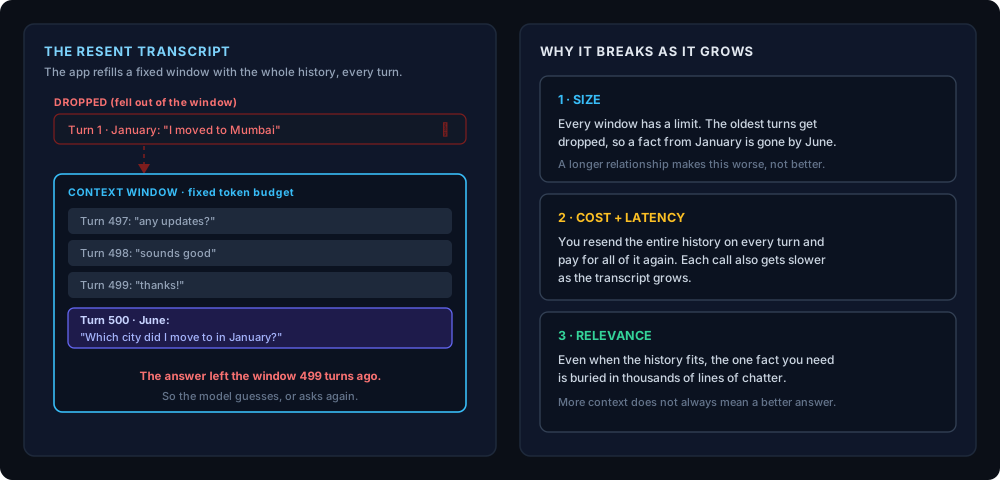
- Transcript-as-memory breaks on three fronts: window size, token cost and latency, and relevance.
- Old facts fall off the window, and the important ones get lost in the noise.
Conversation history is not memory
It is tempting to fix this by saving every message to a database and calling it memory. Storage is necessary, but a pile of past messages is a log, not a memory. A log records what was said. A memory decides what matters, keeps it in a usable form, and brings back the right piece at the right moment.
Turning a transcript into memory takes work the raw log does not do. Something has to read the conversation and pull out the facts worth keeping, separating "I moved to Mumbai" from small talk about the weather. Those facts need a durable home so they survive past the current session. When a new message arrives, the system has to fetch only the handful of facts relevant to it, not the entire past. And when a fact changes, the memory has to update, because a user who moved cities should not be remembered as living in two places at once.
None of that happens on its own. It is a system you build and run, with its own failure modes, and it looks less like a chatbot feature and more like infrastructure.
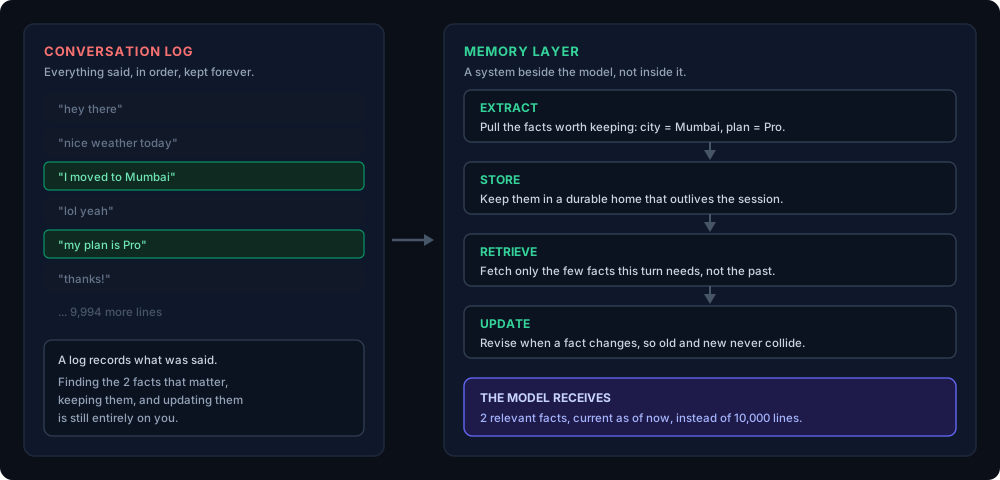
- A stored transcript is a log; memory is selected, structured, retrievable, and kept current.
- Turning conversations into memory is a system you build, closer to infrastructure than a chatbot setting.
Memory is its own layer
Because of all this, teams building serious agents end up treating memory as a separate layer that sits next to the model, not inside it. That layer extracts facts from conversations, stores them so they last, retrieves the few that matter for the current turn, and revises them as the world changes. Done well, the agent stops paying to reread its whole past and starts recalling only what it needs.
This is the problem Suprflo works on: a memory layer for AI agents, built on Postgres, that handles extraction, storage, retrieval, and updates so an agent behaves the same on day one hundred as it did on day one. If you are building an agent meant to last, the memory question shows up whether you plan for it or not. It is worth designing on purpose instead of discovering by accident.